Communication beyond speech —
support for nonspeaking individuals and their families
Not speaking doesn't mean not communicating. Many individuals with complex communication needs have rich inner lives that simply need a different pathway to expression. Affinity Therapy supports nonspeaking individuals and their families in finding, implementing, and expanding those pathways — through augmentative and alternative communication (AAC), sign language, and more.
The Starting Point
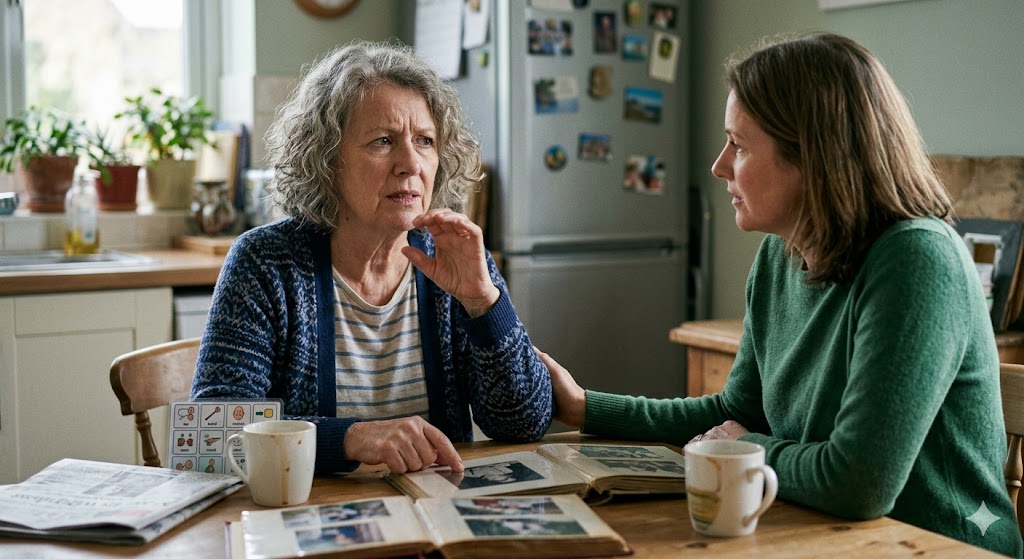
Not speaking is not the same as not communicating. The first step is learning to see what's already there — and then building conditions where more can emerge. That begins with slowing down, observing carefully, and trusting that your loved one has something to say.
See What's Already There
Learning to recognize and honor the communication your loved one is already using — gesture, gaze, expression, movement, and behavior.
Connection Before Compliance
Genuine communication grows from trust and relationship. The foundation is a safe, low-pressure environment where expression is welcomed and honored.
Find the Right Pathway
Every person communicates differently. Together we explore which pathway — or combination of pathways — unlocks the most authentic expression for your loved one.
Working Together
This is a collaborative space where your insight as a caregiver is central. I bring my professional knowledge, and you bring your lived experience. Together, we can build strategies that strengthen communication and make interactions with your loved one more meaningful.
Your Insight is Central
Your lived experience and knowledge of your loved one guides our collaborative approach.
Professional Guidance
I bring clinical expertise in communication disorders and a clear plan for what to do next.
Meaningful Interactions
Building strategies that enhance connection and understanding for the whole family.
My Purpose
My goal is to help your loved one communicate more effectively while learning from your experience what strategies are already meaningful. By combining professional insight with your knowledge, we can work toward communication approaches that truly support connection and understanding.
Learning from Your Experience
- Understanding current communication patterns
- Identifying what already works well
- Recognizing your loved one's preferences
- Building on family strengths
Professional Insight
- Communication strategies that work
- AAC assessment and implementation
- Alternative communication methods
- Ongoing support and adaptation
What we know about awareness
The research on nonspeaking individuals is evolving in ways that matter for families. Conventional assessments have historically underestimated what nonspeaking people comprehend, remember, and experience. The gap between what a person can express and what they are actually aware of is often far wider than standardized tools suggest.
Families often know this intuitively — they observe things about their children that clinical reports don't capture, and they're frequently right. Expressiveness and awareness are not the same thing. A body that struggles to produce speech is not evidence of a mind that struggles to think or feel.
The work here starts from that premise: every nonspeaking person has an inner life that deserves to be honored. The goal is finding every possible pathway to authentic expression.
How Support Works
Communication Partner Coaching
Coaching for caregivers and family members on how to be more responsive communication partners — reading signals, reducing pressure, and creating space for expression.
Observational Assessment
Understanding how your loved one communicates now — what they're already doing, what environments support expression, and what gets in the way.
Expanding Communication
Working together to identify and build on the most accessible and authentic forms of expression for your loved one, across environments and partners.
Family-Centered Planning
Strategies built around your family's real life — practical, adaptable, and grounded in your loved one's strengths and preferences.
Who This Page is For
Parents and Caregivers
Seeking ways to support a non-speaking loved one with meaningful communication strategies and tools.
Families Open to Exploration
Open to exploring AAC devices, sign language, and other communication tools to enhance connection.
Collaborative Approach Seekers
Those interested in collaborative approaches that value both professional guidance and family insight.
Communication Differences We Support
Apraxia
Motor speech disorders affecting the ability to coordinate speech movements, requiring alternative communication methods.
Autism Spectrum Disorder
Supporting individuals on the autism spectrum who may benefit from alternative communication approaches and tools.
Other Communication Differences
Various neurological conditions, developmental delays, and acquired conditions affecting verbal communication.
Ready to Explore Together?
If you are interested in exploring ways to enhance communication with your non-speaking loved one, I invite you to reach out.
Serving Tennessee & Kentucky — marina@affinitytherapytn.com
Frequently Asked Questions
Why a specialist
Adult neurologic communication recovery is my specialty
After a stroke or brain injury, the person is still fully there. Their thoughts, their humor, their personality are all intact. What's changed is the bridge between thought and word, and that bridge can be rebuilt. Helping adults do that, after aphasia, brain injury, and stroke, is the work I trained for in skilled-nursing and outpatient rehab, and the work I care most about.
Credentialed and trained for it
M.S., CCC-SLP, licensed in four states, with clinical training in skilled-nursing and outpatient rehab supporting adults after stroke and brain injury.
Methods that fit you
Approaches with a track record, chosen for your goals and the life you want back.
Virtual across four states
Telehealth in Tennessee, Kentucky, California, and North Carolina, from home.