Gestalt Language Processing
Gestalt Language Processing
When we think about children learning to talk, the common progression goes like this: first words, then two-words, then three words and so on. But language doesn’t unfold the same way for every child. Two distinct patterns exist — Gestalt Language Processing (GLP) and Natural Language Acquisition (NLA) — and understanding the difference can change how we support a child’s language development.
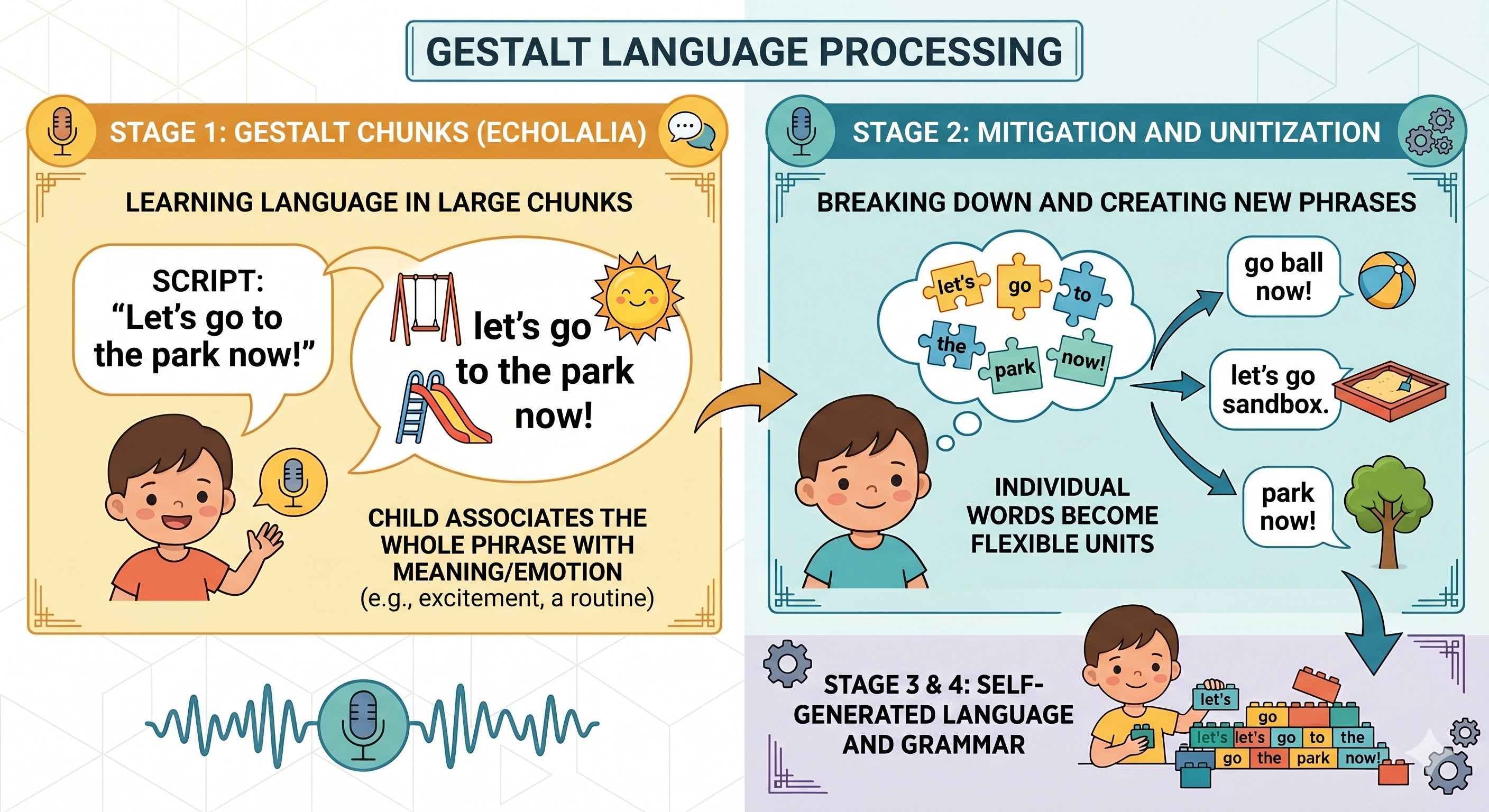
The word gestalt means “whole” — and in terms of language we think of this as a whole chunk of words. Gestalt processors don’t often start with individual words. They learn language in chunks that pair to an emotion or experience. A phrase like “To infinity and beyond!” or “I love you” arrives as one complete unit, inseparable from the feeling attached to it.
These learners often script from TV shows, songs, and movies — not randomly, but because those phrases carry an emotional meaning. This speech can often be characterized as sing song and can be difficult to understand. Many GLP learners also speak minimally in early stages. This isn’t a lack of communication — it’s a different form of it.
With the right support, GLP learners gradually break these chunks apart and recombine them into flexible, original language. “I did it!” might become “I did my puzzle” — a small but meaningful step forward.
Natural Language Acquisition: Building from the Ground Up
NLA learners follow a more familiar path. They start with single words — “ball,” “more,” “hot” — and gradually combine them into longer phrases. Each word is its own unit of meaning, built through exposure and repetition.These learners thrive when adults model simple language and meet the child where they are at building from there. Narrating the world in single words (“Dog! Big dog. Running!”) gives NLA learners exactly what they need — a sound paired with a meaning. From there, they build naturally from exposure: one word becomes two, two becomes three.
The most important takeaway: scripting is not meaningless. When a child repeats a line from their favorite show or a loved one, they are communicating. The meaning lives in the emotion behind the phrase, not always in the words. Caregivers and professionals can help support them by determining what is likely intended by the script. They can also provide models of language the child can use in appropriate contexts (“Let’s go, I did it, Let’s play, etc.”).
Both gestalt and natural language processors are working toward the same destination — effective communication and connection with others. Our role is to recognize which road a child is on, and meet them there.
If you are concerned about which method of processing language your child demonstrates, please reach out to Affinity Therapy speech services for a free consultation.
References
Blanc, M. (2012). Natural language acquisition on the autism spectrum: The journey from echolalia to self-generated language. Communication Supports.
Marina Coakley, M.S., CCC-SLP
I'm a licensed speech-language pathologist (CCC-SLP). I help adults rebuild communication after stroke, brain injury, and aphasia, working with them and the families beside them across Tennessee, Kentucky, California, and North Carolina.
Learn moreReady to Work with Marina?
Schedule a free consultation to discuss how speech therapy can help your family.