How I Read with My 1-Year Old - As An SLP
How I Read with My 1-Year Old - As An SLP
Story time at our house doesn’t always look like what you’d expect. We don’t always get through the whole book. Sometimes we spend five minutes on one page. Sometimes the book ends up in my daughter’s mouth. And honestly? That’s completely fine — because the book was never really the point.
As a speech-language pathologist and a mom, I read with my one-year-old a little differently. Here’s what that actually looks like — and why it works.
We Face Each Other
I make sure we’re face to face. I want her to see my expressions, my mouth, my reactions. Books are a social experience before they’re a literacy one. The back-and-forth between us — her looking at me, then at the book and then back at me — is called joint attention, and research shows it’s one of the most powerful predictors of later language development. Joint attention occurs more commonly during book sharing than in almost any other context, which is one of the reasons reading together is so valuable even at this age.
We Point — A Lot
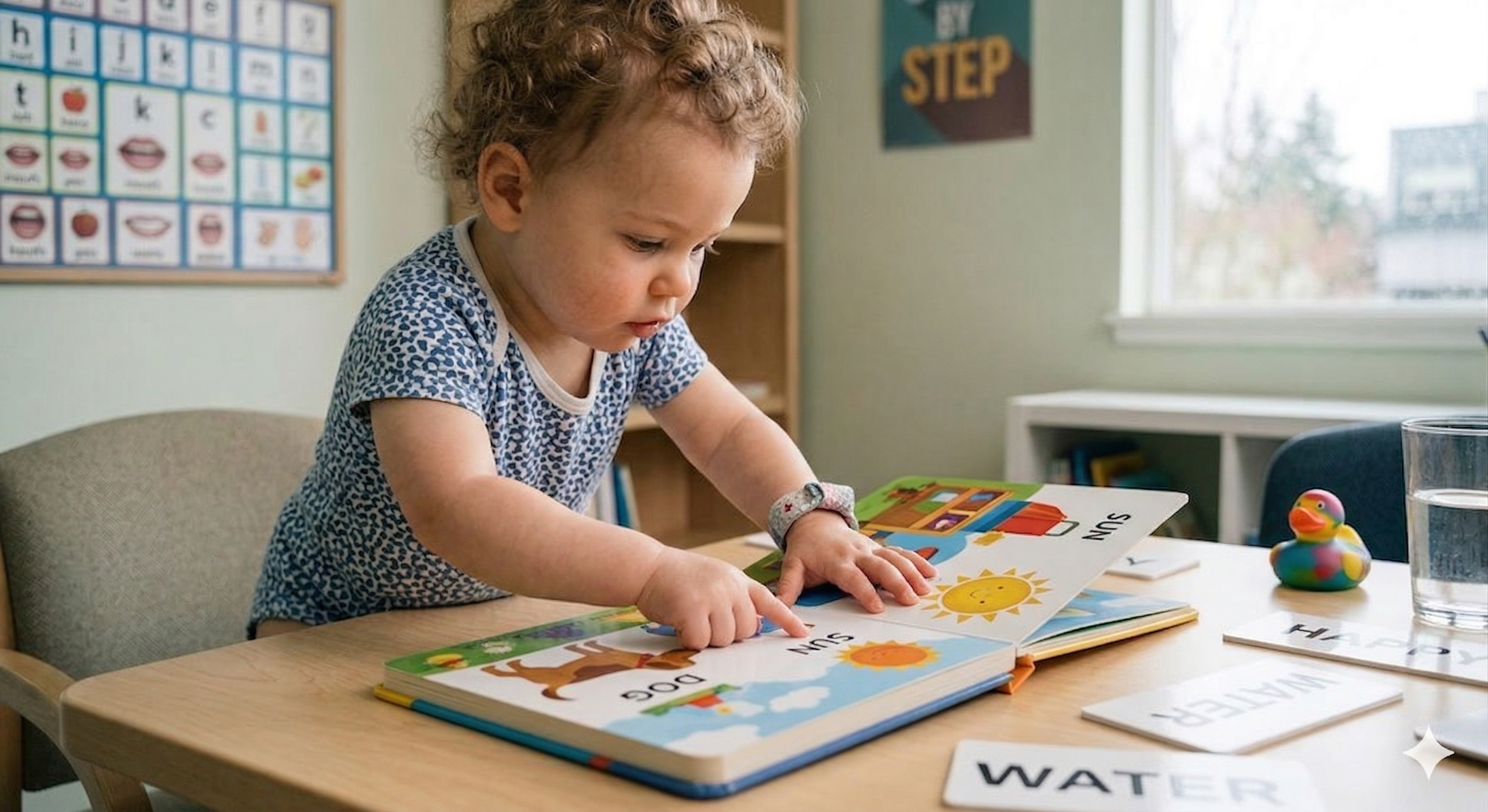
I point to everything. The dog. The ball. The red balloon. And I wait to see if she follows my finger. Research shows that a parent’s use of pointing and gesturing during shared reading is positively linked to the child’s own gesture use — which in turn predicts vocabulary skills later on. So every time I point and name something, I’m not just labeling a picture. I’m teaching her how to direct someone else’s attention — a skill that sits at the very heart of communication.
We Engage With the Book
We pet the animals. We wave bye-bye when a character leaves. We clap, we knock, we make the sounds. Book sharing naturally draws out joint attention and language facilitation in a way that other play routines often don’t. The exposure and repetition of the vocabulary is important in building language skills. When a child physically interacts with a book, they’re connecting language to experience — and that’s where real learning happens.
I Don’t Just Read the Words
I talk about what’s on the page. I narrate what she’s pointing at or seeming interested in. It’s not just reading itself that builds language — frequent everyday conversation during a shared activity like reading is what really moves the needle.
The Bottom Line for Parents
You don’t need a perfect reading routine. You don’t need to finish the book. You just need to show up, follow your child’s lead, and talk about what they’re into. Your child also does not have to be sitting or paying attention to the whole story. You can read the story and still provide the vocabulary exposure. I sometimes give my daughter a book to hold while I read another. However it occurs, those messy, wiggly, one-page-at-a-time reading sessions? They’re doing more than you think.
Resources
Cooper, P. J., Vally, Z., Cooper, H., Sharples, A., Bunn, A., Tomlinson, M., & Murray, L. (2014). Promoting mother-infant book sharing and infant attention and language development in an impoverished South African population: A pilot study. Early Childhood Education Journal, 42(2), 143–152. https://doi.org/10.1007/s10643-013-0591-8
Farrant, B. M., & Zubrick, S. R. (2011). Early vocabulary development: The importance of joint attention and parent-child book reading. First Language, 32(3), 343–364. https://doi.org/10.1177/0142723711422626
Farrant, B. M., & Zubrick, S. R. (2013). Parent-child book reading across early childhood and child vocabulary in the early school years: Findings from the Longitudinal Study of Australian Children. First Language, 33(3), 280–293. https://doi.org/10.1177/0142723713487617
Ho, J., Checkley, R., & Eadie, P. (2023). Mother–infant shared book reading in the first year of life. Infant and Child Development, 32(6), e2465. https://doi.org/10.1002/icd.2465
Mundy, P., & Newell, L. (2007). Attention, joint attention, and social cognition. Current Directions in Psychological Science, 16(5), 269–274. https://doi.org/10.1111/j.1467-8721.2007.00518.x
Rowe, M. L., & Goldin-Meadow, S. (2009). Early gesture selectively predicts later language learning. Developmental Science, 12(1), 182–187. https://doi.org/10.1111/j.1467-7687.2008.00764.x
Snow, C. E., & Goldfield, B. A. (1983). Turn the page please: Situation-specific language acquisition. Journal of Child Language, 10(3), 551–569. https://doi.org/10.1017/S0305000900005365

Marina Coakley, M.S., CCC-SLP
I'm a licensed speech-language pathologist (CCC-SLP). I help adults rebuild communication after stroke, brain injury, and aphasia, working with them and the families beside them across Tennessee, Kentucky, California, and North Carolina.
Learn moreReady to Work with Marina?
Schedule a free consultation to discuss how speech therapy can help your family.